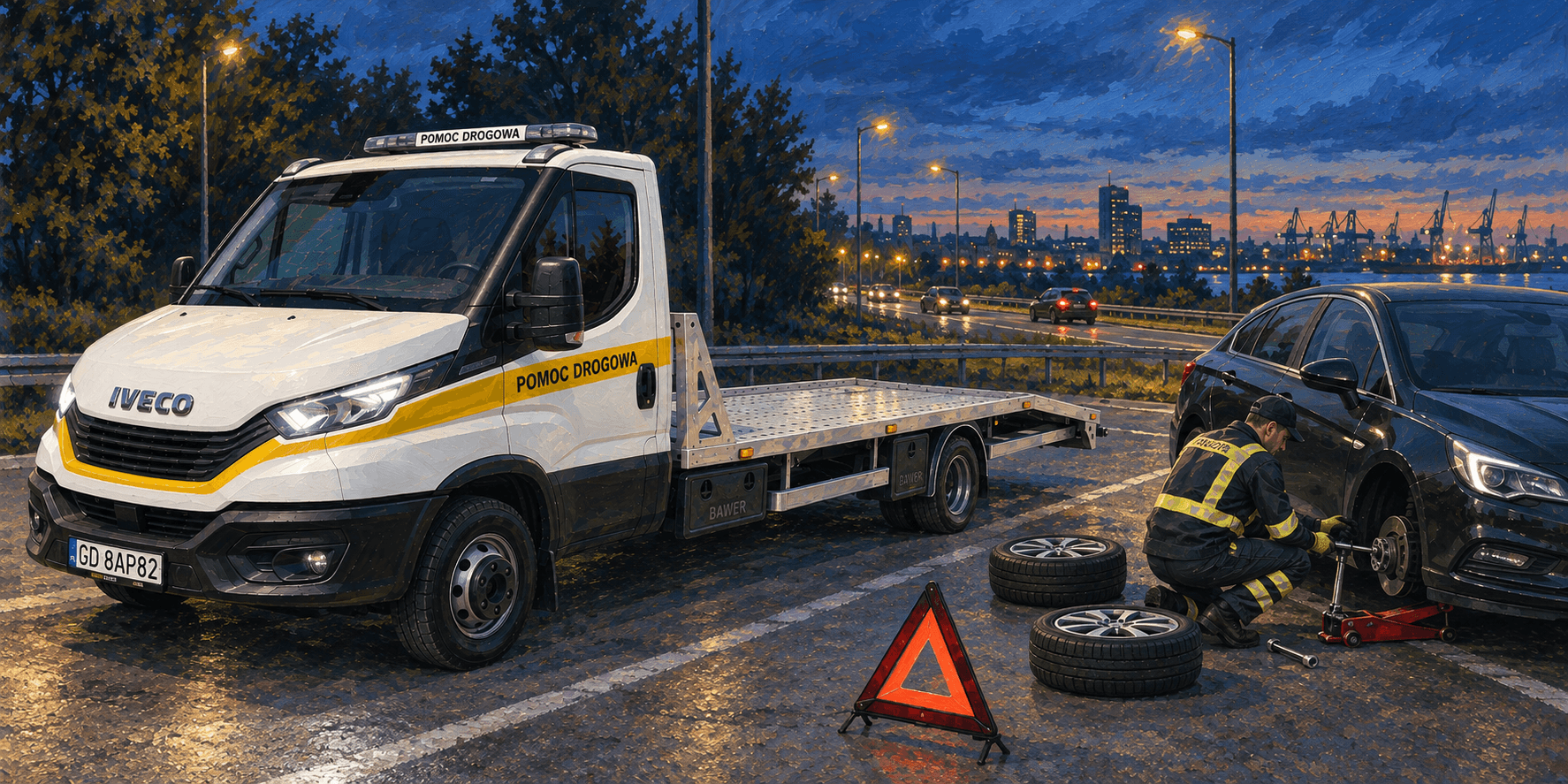
A punctured tyre, damaged wheel rim or sudden loss of pressure can make it unsafe to continue driving. If the vehicle has a suitable spare wheel, accessible jacking points and is standing in a location where the work can be carried out safely, HELP-CAR can change the wheel at the vehicle’s location.
Before setting off, we confirm the vehicle’s location, the type of damage, the availability of a spare wheel and the conditions at the stopping place. Photographs of the wheel and its surroundings help us assess whether a roadside wheel change is likely to be possible or whether transport to a workshop or tyre service will be the safer solution.
When can a wheel be changed at the roadside?
A wheel change is normally possible when:
- the vehicle is standing on firm and reasonably level ground;
- the stopping place is protected from moving traffic;
- a serviceable full-size spare wheel or temporary spare wheel is available;
- the vehicle’s jacking points are not damaged;
- the wheel bolts or nuts can be removed with the correct tool;
- the rim, hub and suspension do not prevent the wheel from being removed;
- there is sufficient space around the vehicle to work safely.
We provide assistance in car parks, on urban streets, in residential areas, at private properties, on business premises and beside roads where the assistance vehicle can be positioned safely.
The final decision on whether the wheel can be changed is made after assessing the location and the condition of the vehicle.
Full-size spare wheel, temporary spare or repair kit
Before calling, check what equipment was supplied with the vehicle. It may have:
- a full-size spare wheel;
- a temporary space-saver spare wheel;
- a tyre repair kit containing sealant and a compressor;
- only a compressor;
- no equipment that would allow the journey to continue.
A wheel can be changed only if the available spare is suitable for the vehicle and safe to use. Its condition and pressure should be checked, together with whether it can be removed from the luggage compartment or its mounting beneath the vehicle.
A space-saver spare wheel is a temporary solution. After it has been fitted, the driver must observe the speed restriction and any other instructions shown on the wheel or in the vehicle handbook.
HELP-CAR does not carry out professional tyre repairs or mobile tyre fitting at the roadside. If the vehicle does not have a suitable spare wheel, transport to a tyre service may be required.
Locking wheel bolts and a missing adapter
Many vehicles have at least one locking bolt or nut on each wheel. A dedicated adapter is required to remove it. This is often stored in the luggage compartment, glove box, vehicle tool kit or close to the spare wheel.
Before assistance arrives, check whether the correct adapter is present and undamaged.
Without the correct adapter, changing the wheel at the roadside may be impossible. We do not use improvised removal methods that could damage the wheel rim, hub or fastening components.
If a bolt or nut is seized, broken, rounded or was previously tightened with excessive force, specialist workshop assistance may be required.
Damage is not always limited to the tyre
After driving into a pothole or striking a kerb or another obstacle, the damage may affect more than the tyre. It may also involve:
- the wheel rim;
- the wheel hub;
- the wheel bearing;
- a suspension arm;
- the shock absorber;
- a steering rod or track rod;
- braking components;
- the wheel arch;
- the underside of the vehicle.
If the wheel has moved from its normal position, is standing at an unusual angle, is locked or is rubbing against the bodywork, changing the wheel alone may not make the vehicle safe to drive.
Do not continue driving if, after a serviceable wheel has been fitted, the vehicle pulls to one side, makes unusual noises, is difficult to steer or displays warning messages.
In these circumstances, transporting the vehicle to a workshop is the safer solution.
A damaged rim or tyre after complete pressure loss
Driving on a tyre with no pressure can damage the sidewall, bead, wheel rim and tyre-pressure sensor. Even when the visible damage appears minor, the tyre may no longer be safe to use.
Do not continue driving simply to reach a safer location if the tyre has completely lost pressure. Further driving may increase the damage and make a later repair more difficult.
When requesting assistance, it is useful to send photographs of:
- the complete damaged wheel;
- the tread and sidewall of the tyre;
- the wheel rim;
- the wheel’s position in relation to the bodywork;
- the location where the vehicle is standing.
Photographs do not replace an inspection at the vehicle, but they help us prepare for the attendance.
A safe place to carry out the work
Changing a wheel requires the vehicle to be raised. The jack must stand on a stable surface, and the vehicle must not be exposed to the risk of being struck by passing traffic.
A wheel change may be impossible or too dangerous if the vehicle is standing:
- on soft ground;
- on a steep slope;
- partly on a kerb;
- on a narrow hard shoulder;
- in a live traffic lane;
- close to a dangerous bend;
- in a location with restricted visibility;
- too close to a barrier, wall or another vehicle.
Not every wheel change that is technically possible should be carried out where the vehicle stopped. The safety of the driver, passengers and roadside assistance operator takes priority over attempting to fit the wheel quickly.
If the location cannot be secured properly, the vehicle may need to be moved or transported.
A vehicle stopped beside a motorway or expressway
If the vehicle has stopped beside a motorway, expressway or another busy route, safety must be dealt with first.
You should:
- switch on the hazard warning lights;
- put on a high-visibility vest before leaving the vehicle;
- position the warning triangle in accordance with the applicable rules and road conditions;
- move passengers to a safe place if this can be done without creating additional risk;
- avoid standing on the side exposed to traffic;
- provide the exact location and direction of travel.
Do not begin changing the wheel on the side exposed to passing vehicles or remain beside the vehicle where the area has not been secured adequately.
After assessing the situation, it may become clear that the vehicle must be transported to a safe location instead of having the wheel changed where it stopped.
What should be checked after the wheel has been fitted?
After the wheel change, check that:
- the wheel is seated correctly;
- the bolts or nuts are tightened correctly;
- the wheel does not rub against the bodywork;
- the vehicle is not visibly leaning;
- there are no signs of suspension or steering damage;
- the journey can be resumed safely.
After fitting a space-saver spare wheel, drive carefully and comply with the manufacturer’s restrictions.
Following any wheel failure, the pressure, bolt tightness and condition of the tyre, rim and suspension should be checked by a service centre as soon as reasonably possible.
What information should you prepare before calling?
Before contacting us, prepare:
- the vehicle make, model and year;
- the exact location or a location pin;
- which side of the vehicle has the damaged wheel;
- photographs of the wheel and stopping place;
- whether a full-size or temporary spare wheel is available;
- the condition of the spare wheel;
- whether the locking-wheel-bolt adapter is available;
- a description of what happened, such as a puncture or an impact with an obstacle;
- whether the wheel is locked or standing at an unusual angle;
- the ground conditions and the amount of free space around the vehicle;
- the telephone number of the person who is with the vehicle.
For a vehicle standing beside a main route, also provide the road number, direction of travel, nearest exit and side of the carriageway.
Roadside wheel change cost
The price depends mainly on the vehicle’s location, the travel distance, the time of the request, access conditions and the extent of the assistance required.
Before setting off, we agree the attendance cost and the cost of the wheel-change attempt with the customer.
The charge covers attendance and the work performed. A successful wheel change cannot be guaranteed before the bolts, adapter, jacking points, spare wheel and safety of the stopping place have been checked.
If the information supplied indicates that a roadside wheel change is unlikely to be possible, we discuss transport to a workshop or tyre service.
Roadside wheel change in the Tricity area
HELP-CAR assists with punctures and other wheel-related problems in Gdańsk, Gdynia, Sopot and the surrounding Tricity area.
Calls are handled directly by the driver, without a call centre. During the call, you can share the location, send photographs and establish whether the wheel can be changed at the roadside or whether transport will be the safer solution.
Call: +48 571 032 062
Prepare the vehicle’s location, a photograph of the damaged wheel and information on whether the vehicle has a serviceable spare wheel and the correct locking-wheel-bolt adapter.