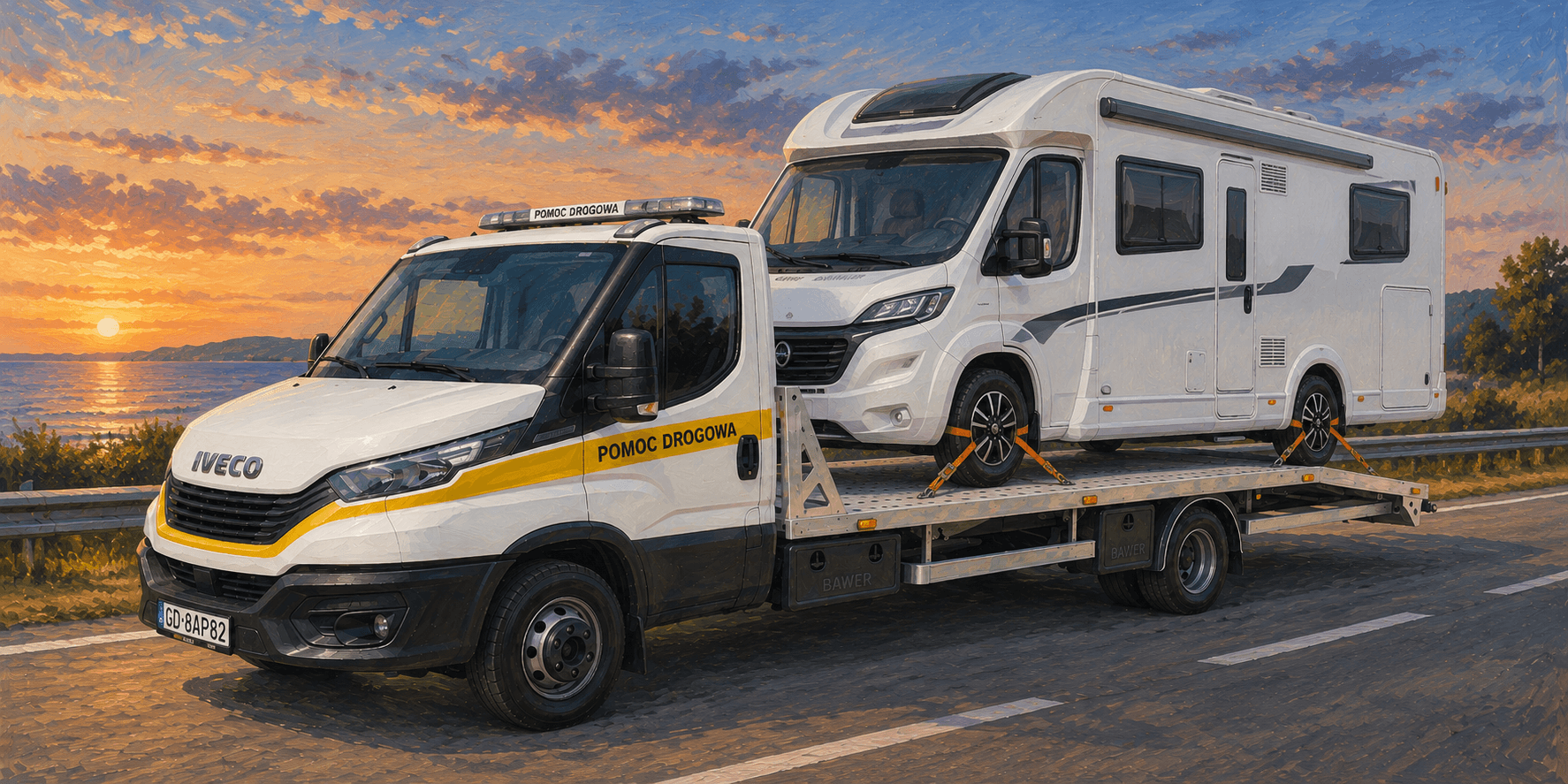
Motorhome transport requires accurate information about its dimensions
A motorhome breakdown on the road or at a campsite
A motorhome may become stranded far from a suitable workshop, in a restricted campsite, on a parking area or during a family trip. In this situation, the distance to the destination is only one part of the assessment. The vehicle’s length, height, weight and access to its current position are equally important.
HELP-CAR assists with mechanical breakdowns, damaged wheels and other incidents after which a motorhome should not continue under its own power. Planned transport is also available — to a workshop, winter storage location, new owner or another destination in Poland or elsewhere in Europe.
Before departure, we confirm the vehicle’s main specifications and the access conditions. This helps us establish whether there is enough space to position the recovery truck and load the motorhome safely.
What motorhome information is needed before transport?
When contacting us, please provide:
- the motorhome’s make and model;
- its overall length;
- its total height;
- its maximum authorised mass or approximate actual weight;
- its wheelbase;
- details of any protruding equipment.
Particularly important items include:
- the awning;
- bicycle rack;
- aerial;
- roof-mounted air conditioning;
- additional body or conversion equipment.
Please also confirm whether the wheels roll freely, whether the steering works and whether the motorhome can be positioned for loading.
Access to the parking location is important
A long and high vehicle needs sufficient room for manoeuvring. Possible obstructions include:
- low entrance gates;
- trees and overhanging branches;
- overhead cables;
- narrow campsite lanes;
- parked vehicles;
- soft or uneven ground.
Photos of the motorhome and its surroundings help us assess the access before arrival. In some situations, it may be safer to move the vehicle to a wider area or agree on a different loading point.
What should be secured inside the motorhome?
Before transport, check that the interior equipment will not move during the journey.
Items that should be secured include:
- loose belongings;
- dishes and kitchen equipment;
- items stored inside cupboards;
- tables and movable parts of the interior;
- equipment carried in the motorhome’s rear garage.
Cupboard, refrigerator and storage-compartment doors should be closed. External items that could extend or open during transport should also be retracted or securely fastened.
Local and long-distance transport
For local transport, we agree on a workshop, secure parking area or another suitable destination in the Tricity area and nearby locations. For longer journeys, we require accurate collection and delivery addresses and confirmation that the vehicle can be unloaded safely at the destination.
It is advisable to confirm in advance:
- the width and height of the entrance;
- the availability of space for the recovery truck;
- whether someone will be present to receive the motorhome;
- whether the vehicle can remain at the location after unloading.
This helps prevent a situation in which the motorhome reaches the destination but there is no suitable access or space for safe unloading.
Direct contact without a call centre
With HELP-CAR, the customer speaks directly to the driver arranging the transport. During one conversation, we discuss the motorhome’s dimensions, technical condition, route, loading conditions and estimated cost.
The information is not passed between several people, and the driver knows in advance what type of vehicle and location to expect.
Useful information to prepare before calling
Please have the following information ready where possible:
- the exact location;
- the motorhome’s make and model;
- its length, height and weight;
- information about the wheels and steering;
- photos of the vehicle;
- photos of the entrance to the campsite, parking area or property;
- the destination address.
These details make it easier to assess the conditions and organise the transport correctly.
Motorhome transport safety
A motorhome cannot be treated in the same way as a standard passenger car. Its height, length, weight and equipment may completely change how the recovery truck must be positioned and where loading can safely take place.
A low entrance, trees, overhead cables, an awning or roof-mounted air conditioning may make it impossible to collect the vehicle from the exact place where it stopped. For this reason, we assess not only the condition of the motorhome but also its surroundings and access to the platform.