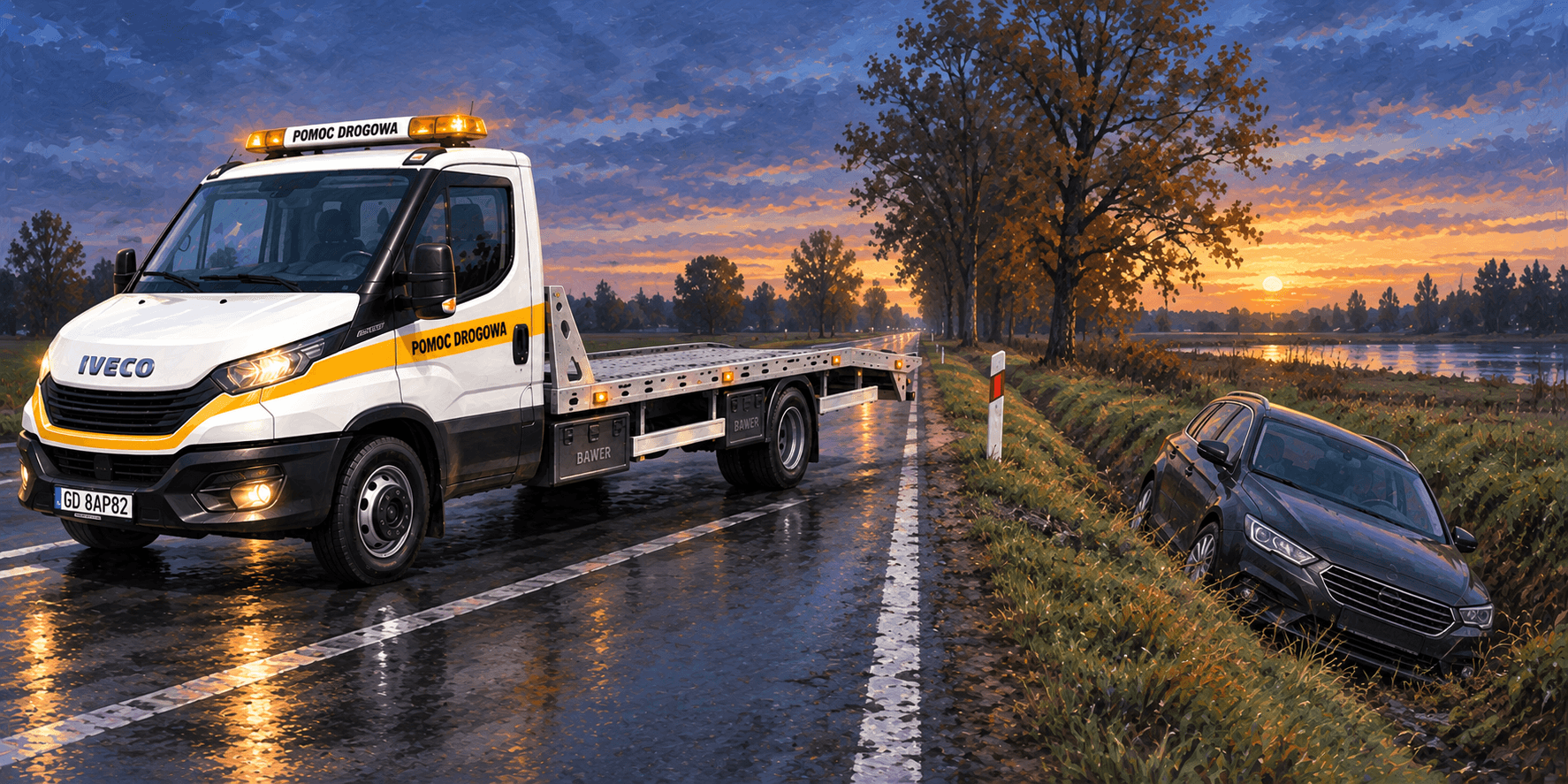
A vehicle may become stuck after leaving the road, moving onto a soft verge or entering a ditch, mud, snow or sand. The recovery method depends not only on the vehicle’s weight, but also on its position, the slope of the ground, the depth to which it has sunk, the condition of the wheels and whether the recovery vehicle can be positioned safely.
HELP-CAR assesses every situation individually. Before setting off, we request the exact location, photographs of the vehicle and surroundings, and information about its technical condition. This allows us to make a preliminary assessment of whether standard winching should be sufficient or whether a different method or additional equipment may be required.
We do not confirm that recovery is possible, or specify the recovery method, without assessing the conditions at the location.
When may a vehicle require recovery?
Assistance may be required when the vehicle:
- has left the carriageway and entered a ditch;
- is stuck on a soft verge;
- is bogged down in mud, snow or sand;
- cannot leave a wet field or an unpaved road;
- has one or more wheels outside the firm road surface;
- is resting on its underside on uneven ground;
- is standing on sloping or unstable ground;
- cannot return to the road under its own power without risking damage.
Two apparently similar situations may require completely different methods because of the weather, type of ground, depth of the ditch and position of the vehicle. A telephone description alone is therefore often insufficient.
Photographs help us assess the situation before attending
Before we arrive, it is useful to send photographs of:
- the front of the vehicle;
- the rear of the vehicle;
- both sides;
- the wheels that are outside the road;
- the underside, if visible;
- the ditch, slope or soft ground;
- the access road;
- the position where the recovery vehicle could stand;
- obstacles close to the vehicle.
The photographs should show the surroundings as well as the vehicle. Trees, posts, fences, barriers, other vehicles, overhead lines, the slope and the width of the road are all relevant.
A short video may also help show the gradient and the vehicle’s actual position.
Photographs do not replace an on-site assessment, but they reduce the risk of attending without the appropriate preparation.
Accurate location and access route
The best option is to send a location pin directly from your phone. If the vehicle is away from a public road, also provide:
- the nearest town or village;
- the road name or route number;
- the direction of travel;
- the nearest exit;
- the distance from a firm road;
- the type of surface on the access route;
- the width of the entrance;
- information about gates and height or weight restrictions;
- whether a larger recovery vehicle can reach the location.
A pin showing only the vehicle’s position may not be sufficient if access is through a closed site, forest, field, narrow entrance or private property.
Do not accelerate aggressively
If the wheels are spinning without moving the vehicle, repeated attempts to drive out may make the situation worse.
Aggressive acceleration can:
- bury the wheels more deeply;
- cause the vehicle to rest on its underside;
- damage the tyre or wheel rim;
- overheat the clutch or gearbox;
- damage drivetrain components;
- move the vehicle towards a ditch, slope or obstacle;
- make subsequent recovery more difficult.
If the vehicle does not move after a controlled attempt, stop further manoeuvres and reassess the situation.
Do not place random objects beneath the wheels if they may be thrown out by the tyre or damage the vehicle.
Vehicle position and the risk of additional damage
Before recovery begins, it is necessary to assess whether the vehicle:
- is standing securely;
- is leaning significantly;
- is partly resting on its underside;
- is touching a tree, barrier or another obstacle;
- has a damaged or locked wheel;
- has visible suspension damage;
- is leaking operating fluids;
- is close to water, a slope or a deeper ditch;
- may change position when pulling begins.
A vehicle may appear stable but can move, rotate or tilt when the load on one wheel changes. Recovery must therefore not begin without assessing the direction of force and the vehicle’s possible path of movement.
Attachment points and safe winch use
A winch cable or recovery strap must not be attached to random parts of the vehicle.
Before starting work, we check whether the manufacturer’s designated towing eye or another suitable structural attachment point can be used.
Do not attach a cable or strap to:
- a plastic bumper;
- body panels;
- pipes or wiring;
- an anti-roll bar;
- random suspension components;
- steering components;
- a towbar whose purpose and condition are unknown.
An unsuitable attachment point may be torn away, causing further damage or creating a danger to people nearby.
While the cable is under tension, bystanders must remain outside the working area.
Stable positioning of the recovery vehicle
Safe recovery requires a location where the recovery vehicle can stand securely and apply the pulling force.
Problems may arise when:
- the entire road is soft or waterlogged;
- the verge collapses under the vehicle’s weight;
- there is insufficient space to position the recovery vehicle;
- the ground has a steep gradient;
- access is blocked by trees, barriers or other vehicles;
- the recovery vehicle would need to stop in a live traffic lane;
- the working area cannot be secured.
If the recovery vehicle itself cannot be positioned securely, the attempted recovery may be unsafe or ineffective.
When may additional equipment be required?
Standard equipment may not be sufficient when:
- the vehicle is in a deep ditch;
- it is leaning significantly;
- it is lying on its side or roof;
- the wheels or suspension are seriously damaged;
- it is far from a firm road;
- the ground cannot support the recovery vehicle;
- lifting is required rather than pulling alone;
- access is possible only from a direction that increases the risk of damage;
- the vehicle is heavy, loaded or has an unusual construction.
In such cases, a second recovery vehicle, an additional winch, lifting equipment, a crane or other specialist equipment may be required.
If the conditions exceed what can be handled safely with the available equipment, we explain that another solution is necessary. We do not promise to recover every vehicle from every location.
Can the vehicle be driven after recovery?
Moving the vehicle back onto a firm surface does not automatically mean that it is roadworthy.
After leaving the road or striking an obstacle, damage may affect:
- tyres and wheel rims;
- suspension;
- steering;
- braking components;
- the underside;
- the exhaust system;
- engine undertrays;
- pipes, wiring and reservoirs;
- bodywork.
After recovery, check whether:
- the wheels are positioned correctly;
- there are any visible leaks;
- any part is touching the road surface;
- the steering operates normally;
- the brakes respond correctly;
- warning messages have appeared on the dashboard.
If damage is suspected, the vehicle should not continue its journey. Transport to a workshop may be the safer solution.
Passenger and incident-site safety
If the vehicle is close to a busy road, securing the location and passengers is the first priority.
You should:
- switch on the hazard warning lights;
- put on a high-visibility vest before leaving the vehicle;
- mark the location in accordance with the applicable rules and conditions;
- move passengers to a safe place if this can be done without risk;
- avoid standing between the vehicle and the road;
- do not stand below a vehicle positioned on a slope;
- do not touch damaged cables, pipes or spilled fluids.
If the vehicle is unstable, do not return to the interior to collect belongings until the risk has been assessed.
What information should you prepare before calling?
Before contacting us, prepare:
- the vehicle make, model and year;
- the exact location or a location pin;
- photographs of the vehicle from several sides;
- photographs of the access road;
- a description of the ground;
- information about the gradient;
- the approximate distance from a firm road;
- the number of wheels outside the road surface;
- whether the vehicle is standing securely;
- whether the engine can be started;
- whether the steering operates;
- details of visible damage and leaks;
- information about obstacles near the vehicle;
- the telephone number of the person at the location.
If the vehicle is carrying cargo, this must also be reported. The weight and movement of the load may affect stability and the recovery method.
Vehicle recovery cost
The price depends mainly on:
- the location;
- travel distance;
- the vehicle’s position;
- the type of ground;
- the gradient;
- whether the recovery vehicle can be positioned safely;
- the time required to secure the location;
- how deeply the vehicle is stuck or how far it is leaning;
- the vehicle’s technical condition;
- whether additional equipment is required;
- any transport required after recovery.
Photographs and a description allow a preliminary assessment of the assistance required. The final recovery method can only be confirmed after the conditions have been checked at the location.
If it is clear before departure that standard equipment may not be sufficient, we explain this before accepting the request.
Vehicle recovery in the Tricity area
HELP-CAR assists vehicles stuck in ditches, mud, snow, sand or on soft verges in Gdańsk, Gdynia, Sopot and the surrounding Tricity area.
Calls are handled directly by the driver, without a call centre. During the call, you can share the location, send photographs, describe the situation and make a preliminary assessment of the most appropriate form of assistance.
Call: +48 571 032 062
Prepare a location pin, photographs of the vehicle and surroundings, and information on whether the vehicle is stable, whether the engine starts and whether the steering operates.