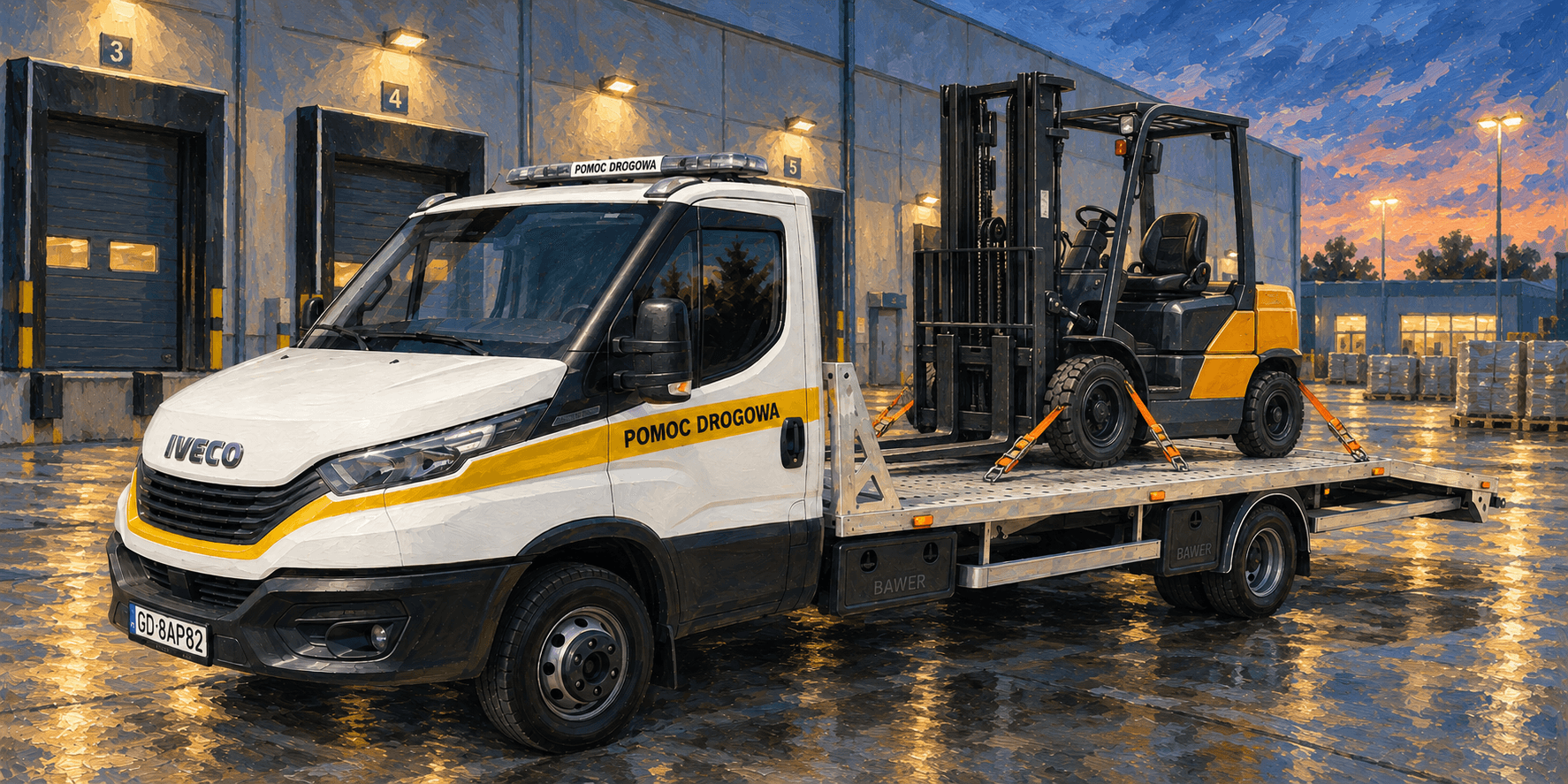
HELP-CAR provides individual transport of forklifts between warehouses, industrial facilities, workshops, ports, logistics centres and other agreed locations. The service is intended for companies, service centres, rental businesses, dealers and machine owners who need a specific forklift transported at an agreed time.
We do not provide regular routes, consolidated transport or freight-forwarding services. Each forklift is assessed separately based on its actual weight, dimensions, technical condition and the loading and unloading conditions.
Which forklifts can be assessed for transport?
We can assess compact electric, diesel and LPG forklifts where their weight, length, width and height are compatible with the platform.
Transport may involve a forklift collected following a purchase or sale, delivered to a service centre, moved between company branches, collected from a warehouse or logistics centre, delivered to a production facility, transported after a breakdown or returned to a rental company.
A forklift weighing less than 5 tonnes is not automatically suitable for transport. Lowered mast height, fork length, wheelbase, centre of gravity and positioning on the platform must also be checked.
What information is required for a quotation?
Before confirming transport, provide:
- make and model;
- actual unladen weight;
- total length;
- width;
- transport height;
- mast height in its lowest position;
- fork length;
- electric, diesel or LPG power type;
- whether the forklift starts, drives and steers;
- wheel and steering condition;
- information about any leaks;
- photographs from all sides;
- photographs of loading and unloading areas;
- exact addresses and location pins.
For an electric forklift, provide the battery condition. For an LPG forklift, confirm whether a cylinder is installed. All parts must be prepared so that they cannot move during transport.
Loading and securing the forklift
Loading is simplest when the forklift can be started and safely driven onto the platform. A non-running forklift may also be accepted, but it requires an individual assessment.
The mast should be fully lowered and the forks placed in a safe position. Long, projecting or removable forks must be reported before departure.
The forklift is secured at points suitable for its construction. The securing method depends on weight, centre of gravity, wheel type and machine design.
Collection from a warehouse, port or restricted site
Collection may take place from a warehouse, production facility, port, logistics centre, company yard or service centre. Before arrival, confirm that the location provides safe vehicle access and sufficient positioning space.
Restricted sites may require advance vehicle registration, security approval, driver details, a specific gate number and an on-site contact.
The HELP-CAR vehicle is approximately 2.3 m high. For indoor loading or restricted gates, the available height, width and manoeuvring space must be checked in advance.
Platform limits and transport price
The HELP-CAR platform has a capacity of up to 5 t, a length of 6.2 m and a width of 2.3 m.
The approximate transported-load height without additional permits may be up to 3.3 m, but final approval depends on the total loaded height and the construction of the machine.
Transport may be refused where the weight or dimensions exceed the platform limits, the machine has an uncontrolled leak, damaged wheels or steering prevent safe loading, access is unsuitable or the forklift cannot be secured correctly.
The price is agreed before departure and depends on distance, machine dimensions, technical condition, loading method and access at both locations.