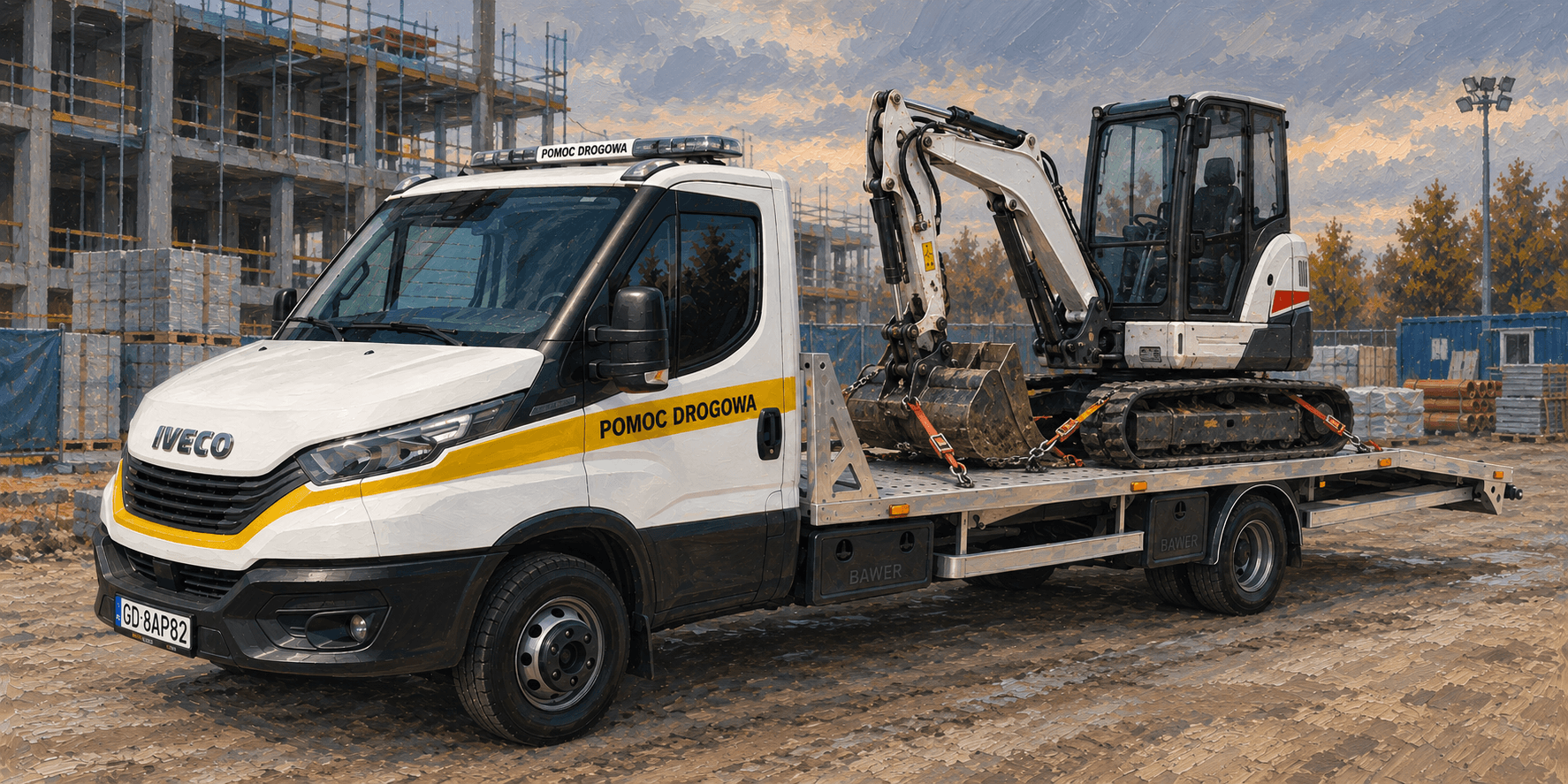
HELP-CAR provides individual transport of compact construction machinery for companies, contractors, rental businesses, service centres and machine owners. Transport may be required following a purchase, for delivery to another work site, for servicing, return to a rental company or collection of a non-running machine.
Each order requires advance verification of weight, dimensions, centre of gravity, attachments and loading conditions. We do not transport full-size excavators, heavy loaders or machinery requiring a specialist low-loader.
Which compact machines can be assessed?
We can assess tracked and wheeled mini excavators, skid-steer loaders, compact wheeled loaders, compact tracked loaders and other small construction machines with compatible parameters.
The term “mini excavator” alone is not sufficient to confirm transport. Models vary significantly in weight, width, height and length when the boom and bucket are placed in transport position.
Actual weight may be increased by a quick coupler, bucket, hydraulic breaker, other attachments or a full fuel tank.
What information is required?
Provide:
- make and model;
- operating weight;
- transport length;
- width;
- transport height;
- track or wheel width;
- undercarriage type;
- installed attachment;
- boom and bucket position;
- additional attachments;
- whether the machine starts and moves;
- condition of tracks, wheels, brakes and controls;
- details of any leaks;
- photographs from all sides;
- photographs of the access and loading area;
- collection and delivery addresses.
Preparing the boom, bucket and attachments
Before loading, the boom and bucket must be placed in a safe transport position. Parts must not move freely or extend beyond the agreed dimensions.
Additional buckets, hydraulic breakers, augers, grabs and other attachments affect the total weight, length, centre of gravity, available platform space and securing method.
Tracks should be cleaned of heavy mud, stones and construction material. A machine with a visible hydraulic-oil, fuel or other fluid leak may be refused.
Loading from a construction or industrial site
The loading surface should be firm, reasonably level and provide sufficient space for positioning the tow truck. Soft ground, deep mud, excavations, high kerbs or restricted manoeuvring space may prevent loading.
Before arrival, check the gate width, access-road condition, overhead cables and structures, turning space and site-entry rules.
For a non-running machine, its exact position must be described. Collection from a hard-standing area is different from loading machinery located in mud, an excavation or on a slope.
Platform limits and price
The HELP-CAR platform has a capacity of up to 5 t, a length of 6.2 m and a width of 2.3 m.
The approximate machine height without additional permits may be up to 3.3 m, but the total loaded height must always be verified.
HELP-CAR does not transport full-size excavators, heavy loaders, multiple machines, oversized construction machinery or equipment requiring a specialist low-loader.
The price is agreed before departure and depends on the route, actual weight, dimensions, attachments, technical condition and access at both locations.