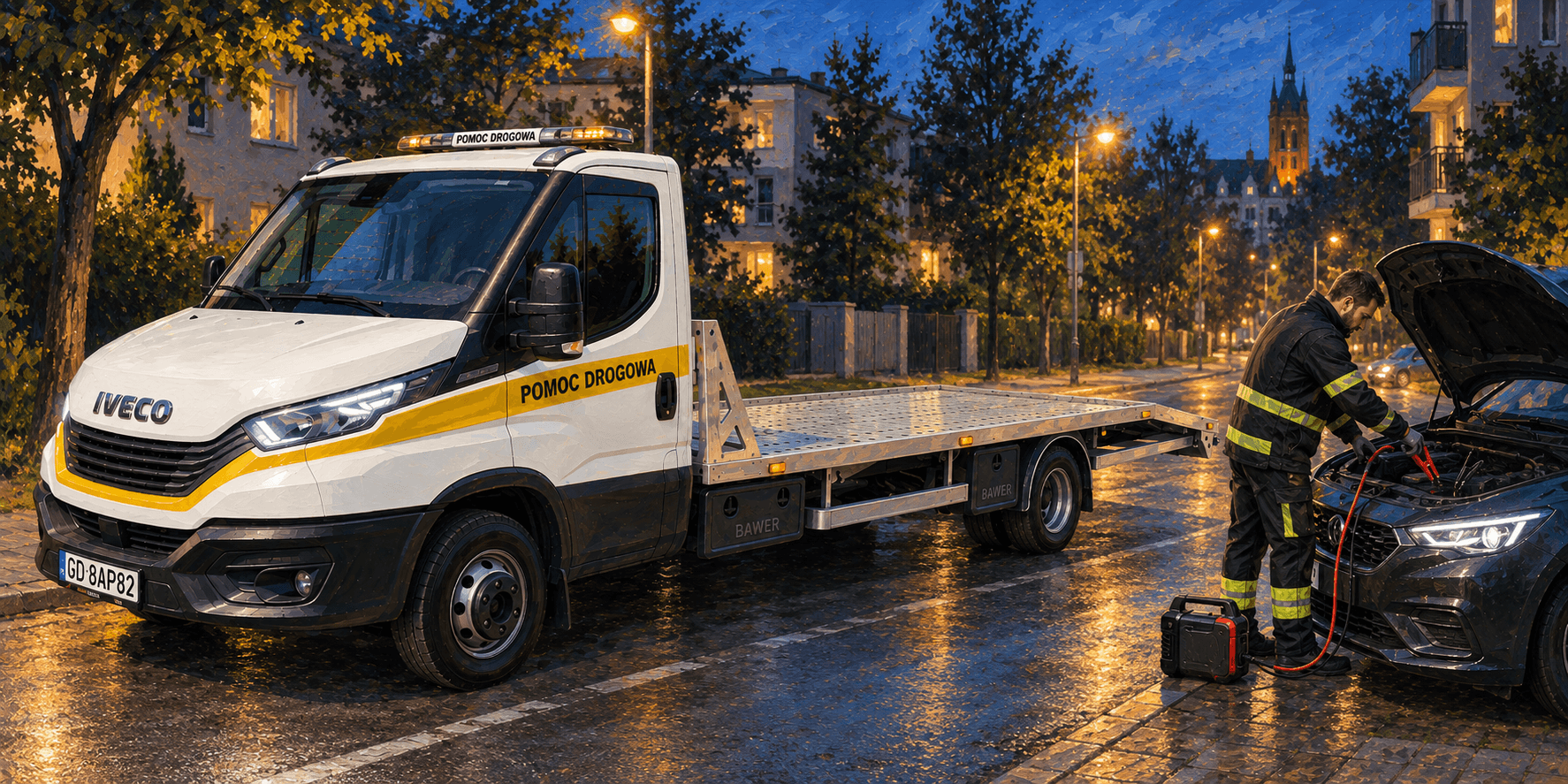
A discharged battery can prevent a vehicle from starting outside your home, in a car park, at work, in an underground garage or by the roadside. HELP-CAR attends with a professional jump-start unit and carries out a safe attempt to start the vehicle at its location.
Before setting off, we confirm the symptoms, the type of vehicle, its location and the access conditions. This helps us assess whether the problem is likely to be related to the battery or whether the vehicle may require diagnostics or transport on a recovery platform.
Signs of a weak or discharged battery
Battery problems can present in several ways. The most common signs include:
- the starter motor turning slowly;
- dashboard lights dimming during a starting attempt;
- one or more clicking sounds;
- no response after turning the key or pressing the START button;
- the central locking not working or the lights appearing weak;
- warning messages concerning low voltage or the electrical system.
When calling, explain how long the vehicle has been standing, whether it previously had starting problems and whether the lights, radio, central locking and other electrical systems are working.
These symptoms alone do not confirm that the battery is the only cause of the problem.
Not every starting fault is caused by a discharged battery
A jump-start unit can help when the problem is genuinely caused by low battery voltage or a temporary lack of sufficient electrical power.
If the vehicle still does not start after the unit has been connected correctly, the cause may include:
- a faulty starter motor;
- a faulty alternator;
- a problem with the electrical system;
- an immobiliser or key fault;
- a fuel-system fault;
- an electronic control-system error;
- another mechanical or electrical failure.
We do not make repeated, uncontrolled attempts to start the vehicle at any cost. This could damage the electrical system, discharge the battery further or make subsequent diagnostics more difficult.
If the jump-start attempt is unsuccessful, the driver will discuss the available next steps with the customer, such as contacting a workshop, arranging diagnostics or transporting the vehicle on a recovery platform.
Safe connection of the jump-start unit
Before connecting the unit, we check access to the battery or to the dedicated jump-start terminals specified by the vehicle manufacturer.
In some vehicles, the battery is located beneath a cover, in the luggage compartment, under a seat or in another difficult-to-access position. Modern vehicles may also require a specific connection sequence.
Do not connect improvised leads to unmarked parts of the electrical system. Reversed polarity or the use of an incorrect connection point can damage the vehicle’s electronics.
If the battery is cracked, deformed, overheated, producing an unusual smell or showing signs of leakage, a jump-start attempt may be unsafe and should not be carried out.
Hybrid and electric vehicles
When calling, state whether the vehicle has a petrol or diesel engine, is a hybrid or is fully electric. The correct assistance procedure depends on the vehicle’s construction and the manufacturer’s instructions.
In hybrid and electric vehicles, the problem may involve the auxiliary 12 V battery. This does not necessarily indicate a fault or loss of charge in the main traction battery.
We do not work on the high-voltage system. Before attempting a jump-start, the driver assesses whether a jump-start unit can be connected safely to the vehicle’s 12 V system.
Access to a vehicle in a garage or car park
For a vehicle in an underground garage, provide:
- the level on which the vehicle is parked;
- the maximum entrance height;
- the parking-space number;
- details of how the gate or barrier can be opened;
- information about entry restrictions and access limitations;
- whether the assistance vehicle can stop close to the car.
Direct access may be difficult in garages, confined car parks and locations with narrow entrances. It is therefore useful to send photographs of the entrance and the vehicle’s parking position in advance.
At business premises, residential developments or private properties, also confirm whether access must be registered with security staff or approved by the site manager.
A vehicle stopped by the roadside
If the vehicle has stopped beside a busy road, at a junction or in a position that obstructs traffic, describe the situation accurately during the call.
First ensure the safety of passengers, switch on the hazard warning lights and mark the vehicle appropriately. A jump-start attempt should not be made where the roadside assistance driver cannot position the assistance vehicle and work safely.
In some situations, moving or transporting the vehicle first will be the safer solution.
What should you do after the engine starts?
Starting the vehicle does not mean that the underlying cause has been resolved. The battery may be worn out or insufficiently charged, or the vehicle may have a fault in its charging system.
After a successful jump-start, check whether:
- any warning lights remain illuminated on the dashboard;
- the engine is running correctly;
- the charging system is reporting a fault;
- the vehicle stalls after the jump-start unit is disconnected;
- it is safe to continue driving.
Do not switch the engine off immediately if you are unsure whether the vehicle will restart. However, leaving the engine idling briefly will not solve the problem of a worn-out battery.
If warning messages appear, the engine runs irregularly or the problem returns, the battery and charging system should be checked by a workshop.
What information should you prepare before calling?
Before contacting us, prepare:
- the vehicle make, model and year;
- whether the vehicle has a petrol or diesel engine, is a hybrid or is fully electric;
- a description of what happens during a starting attempt;
- whether the starter motor turns;
- whether the dashboard lights remain normal or become dim;
- how long the vehicle has been standing unused;
- details of earlier warnings or starting problems;
- the exact location or a location pin;
- the conditions of access to the vehicle;
- the entrance height if the vehicle is in a garage;
- the telephone number of the person who is with the vehicle.
An accurate description of the symptoms helps us prepare the appropriate equipment and reduces the risk of attending a vehicle that requires a different type of assistance from the outset.
Vehicle jump-start cost
The price depends mainly on the vehicle’s location, the travel distance, the time of the request and the access conditions.
Before setting off, we agree the attendance cost and the cost of the jump-start attempt with the customer. The charge covers attendance and the service performed, not a guaranteed start, because the final cause of the fault may be unrelated to the battery.
If the description suggests that the vehicle is likely to require diagnostics or transport, we explain this before accepting the request.
Vehicle jump-start assistance in the Tricity area
HELP-CAR assists with vehicle starting problems in Gdańsk, Gdynia, Sopot and the surrounding Tricity area.
Calls are handled directly by the driver, without a call centre. During the call, you can describe the symptoms, share the location and establish whether the appropriate solution is a jump-start attempt, diagnostics or transport on a recovery platform.
Call: +48 571 032 062
Prepare the vehicle’s location, make and model, together with an accurate description of what happens when you attempt to start it.